
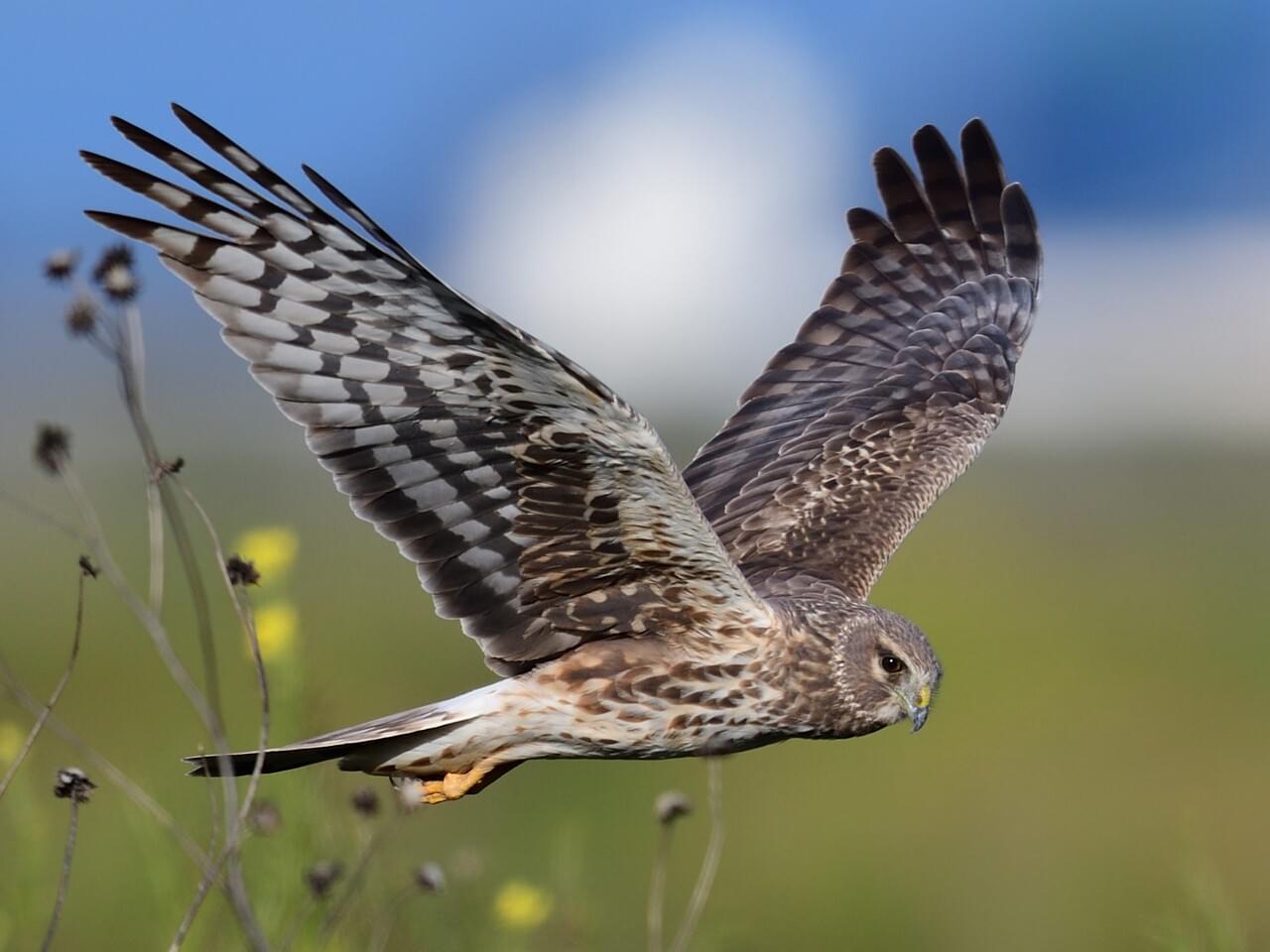
They fly low over the marshes and prairies soaring with their wings in a dihedral or V-shaped form…their white rump patch very conspicuous. As they bank and soar and dive, their senses of sight and sound are keen for their prey. Chief among their prey are voles and mice.
Once common in Indiana, the marsh hawk is now listed as “State-endangered.” The reason for this listing is that the bird of prey is nearing extirpation due to loss of habitat. Marsh hawks or Northern harriers are true grassland birds. They nest on the ground amongst the native grasses of the prairie and marsh. In order to live and roam and raise their offspring, they need large, wide open spaces devoid of much brush and trees and filled with native grasses, sedges, bulrushes, and forbs.
Pigeon River Fish and Wildlife Area in LaGrange County, Indiana boasts 12,000 acres of protected land managed for hunting opportunities. The land was much of it farmed prior to the early 1950’s. The power of the Pigeon was harnessed earlier. Three dams were built to provide grain milling and hydroelectric generation. The sandy lands and the peatlands of the Pigeon River valley turned out to be marginal at best for productive agriculture back then. When the hydroelectric dams were decommissioned, the State bought the dams and the land and converted the land use to wildlife habitat. Much of the land was planted by staff of Pigeon River Fish and Wildlife Area. Rows and strips of non-native conifers, autumn olive, Asian bush honeysuckle, and annual grain fields were designed to create ample edge conditions and habitat for game animals. Tenant farmers were contracted to plant corn and soybeans annually with a requirement to leave a few rows un-harvested for food for game.
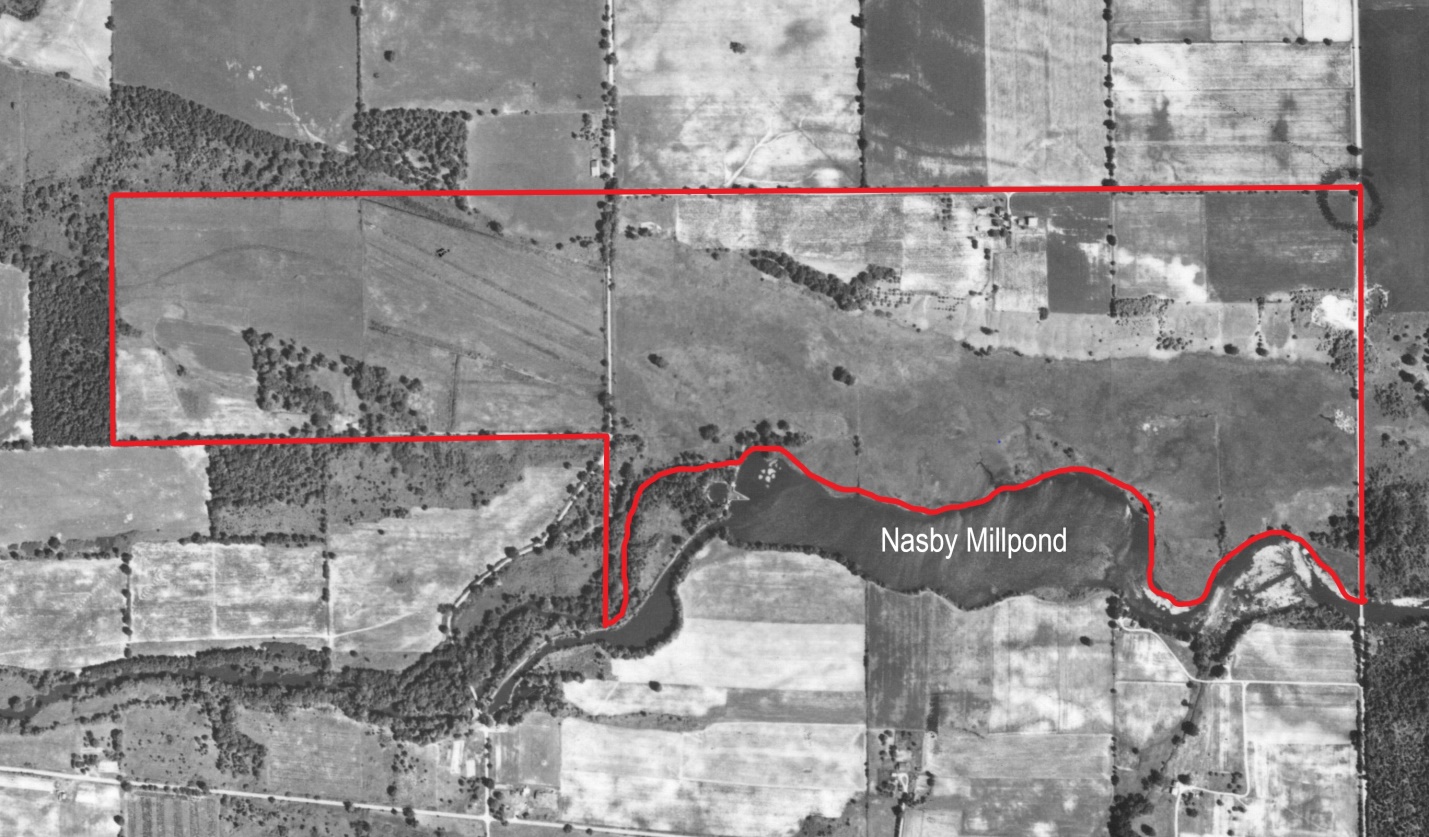
Amidst all the land conversion, a few high-quality nature areas remained. The remnant prairie fens of the valley were dedicated as State nature preserves. One of the feature fens is known as Nasby Fen. The fen is adjacent to the Nasby millpond and Nasby Dam.
Nasby Fen Nature Preserve, owned by Indiana Department of Natural Resources, Div. of Fish and Wildlife (DFW) and maintained by Div. of Nature Preserves (DNP), is the largest prairie fen complex in Indiana. The ecologically-significant Nasby Fen complex is home to 7 State-listed avian species, 30 State-listed insect species, 36 State-listed plant species, 7 new (2022) State distribution records for spiders, and 1 State-listed and 1 Federally-listed herpetofauna.
Nasby Fen Nature Preserve includes 65 acres of high-quality prairie fen wetland. The adjoining 19-acre slope known as Nasby Overlook Prairie was restored to prairie and oak barrens by Blue Heron Ministries about 15 years ago through various grants and partnerships.
Invasive plant species pressure from immediately adjacent uplands and wetlands threaten Nasby Fen and Overlook Prairie. Following now-ceased tenant farming, the adjacent uplands (abandoned fields and fencerows) are invaded by non-native herbaceous and woody species. An abandoned gravel pit is colonized with invasive brush and tree species. The adjacent peatland wetlands west of Nasby Fen are partially drained by excavated drainage ditches resulting in depressed groundwater levels and have been converted from a diverse sedge meadow community to a near monoculture of reed canary grass.
Blue Heron Ministries, in partnership with Pigeon River Fish and Wildlife Area and the Division of Nature Preserves, saw the opportunity to protect the work that had already been accomplished to maintain the high quality of Nasby Fen and Overlook Prairie and to expand both peatland and upland prairie habitat.
Early in 2023, Blue Heron Ministries applied for a Sustain Our Great Lakes (SOGL) grant through the National Fish and Wildlife Foundation (NFWF). The proposal sought to control invasive species and replace them with native, upland and wetland grassland species within Nasby Fen, the Overlook Prairie landscape, and the adjacent wetlands and uplands.
Though a good-enough project, the proposal needed a hook to catch the eye (ouch!) of the grantmakers. After a phone conversation with NFWF staff, it was revealed that the Foundation likes birds. Well, Nasby Fen has a good list of State-listed avian species: sedge meadow grassland birds (State-endangered Sedge Wren and Marsh Wren), secretive marsh birds (State-endangered Least and American Bittern, and Virginia and Sora Rail), and the State-endangered grassland bird…our Northern Harrier (Marsh Hawk). Due to its need for large expanses of contiguous native grassland habitat, the marsh hawk became the icon or signature species for the proposal that would effectively restore 235 contiguous acres of indigenous grassland habitat.
That bird, and the fact that Blue Heron Ministries had successfully completed a similar prairie fen restoration at LaGrange County Park’s Duff Lake Fen under another SOGL grant, paved the way for a new project. The grant application was successful!
A new SOGL grant will provide the opportunity to continue management of the original project area consisting of 84 acres of protected fen wetland and associated upland habitat, then expand from there to restore 151 acres of degraded adjacent wetlands, prairie, and declining oak savanna. Through the control of both wetland and upland invasive plant species, a large contiguous 235-acre prairie fen and prairie-oak savanna continuum rich with grasses, sedges, and forbs will be created for the benefit of the State and Federally-listed species per State and Federal conservation plans and guidelines.
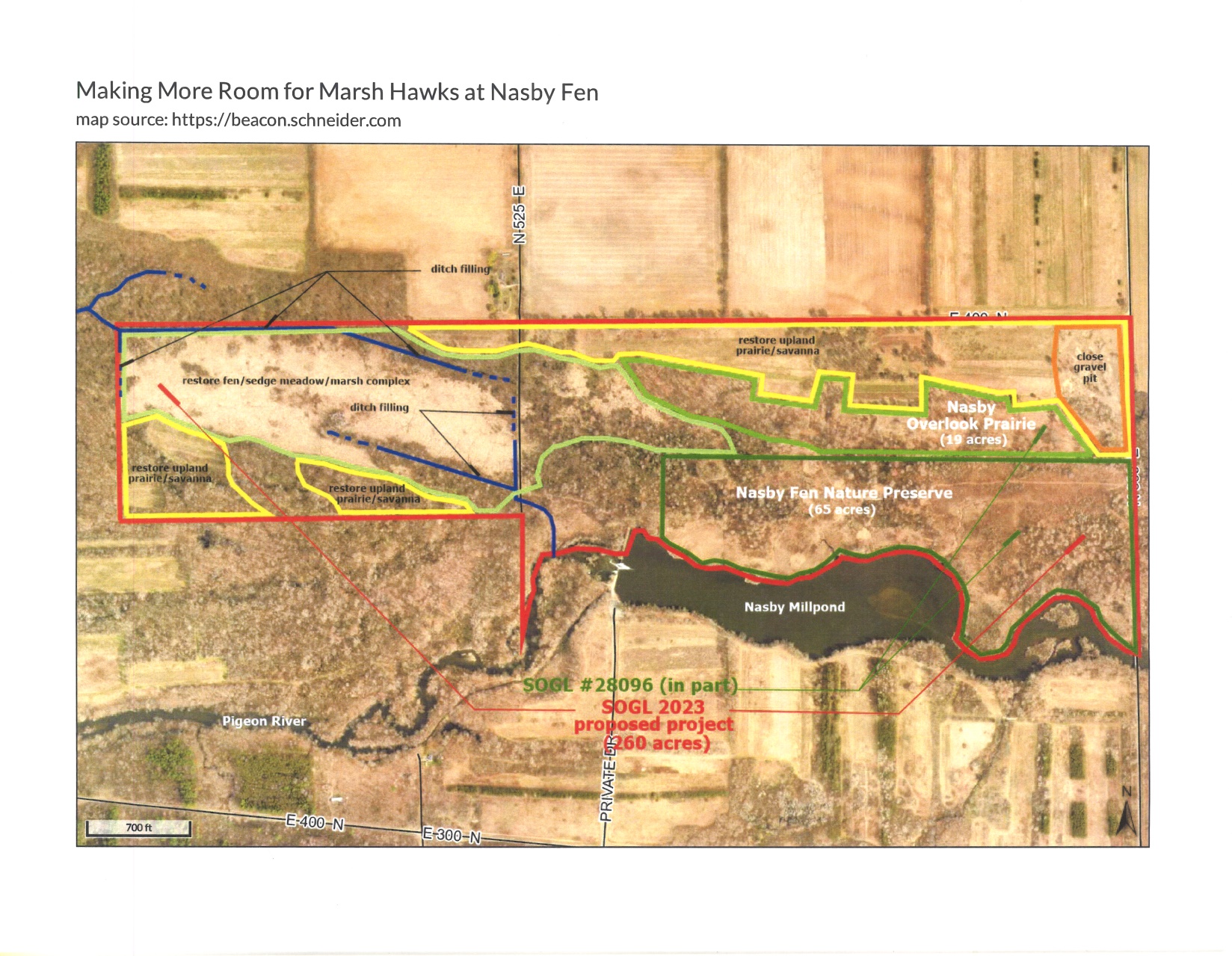
Beginning in January, 2024 crews from the three partners and two private contractors will work together for the next three years to maintain and restore prairie fen, sedge meadow, dry prairie, and oak savanna. Invasive species will be controlled with targeted and broadcast herbicide applications. Brushy fencerows filled with invasive shrubs and trees will be removed. White, black, and bur oak trees will be protected. Nearly a mile of excavated drainage ditches will be filled in order to restore groundwater hydrology. At least 51 acres of former agricultural old fields will be converted to native prairie-oak savanna, and at least 57 acres of reed canary grass fields will be converted to native wet prairie, sedge meadow, and shallow marsh. Hundreds of pounds of native prairie seed will be collected and sown. And the entire grassland continuum will be maintained with frequent fire.
And the hope is that the marsh hawk will find its expanded home in the Pigeon River valley suitable to receive the blessing to be fruitful and multiply.
 Blue Heron Ministries